Why the Deaflympics Are More Than a Competition
In this blog post, our Head of Community, Matt Sherman, reflects on his experience at the Deaflympics in Tokyo and why it matters deeply for the deaf and hard of hearing community.

A Global Stage Built on Access
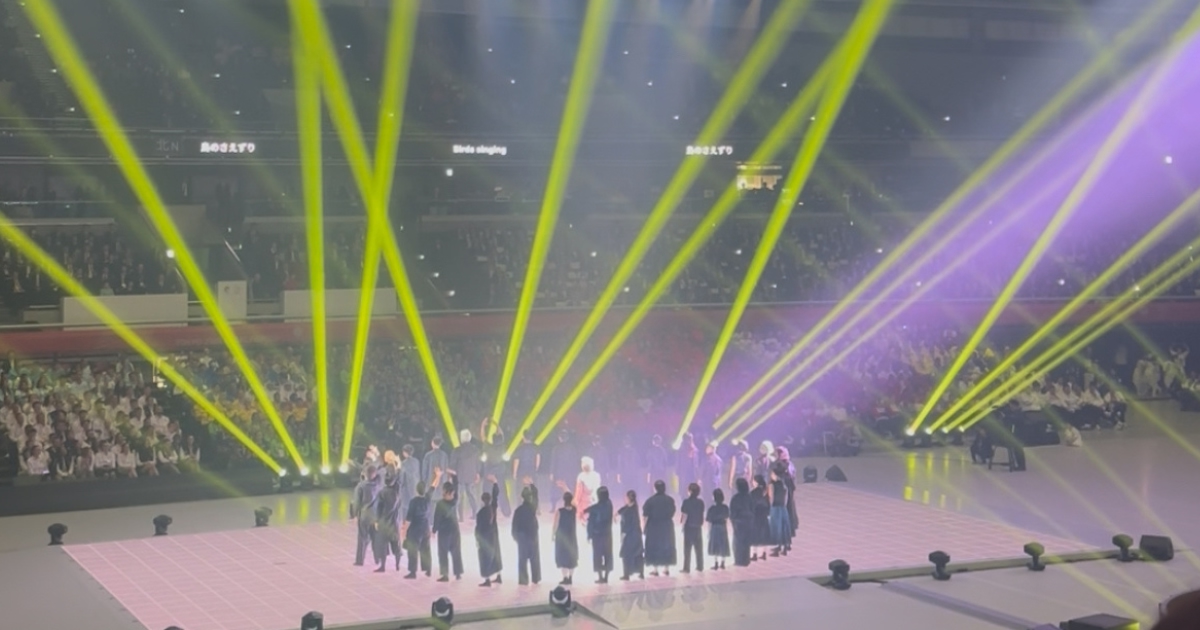
This year marked the 100th anniversary of the Deaflympics. Nearly 2,800 athletes from 79 countries and regions competed. Hundreds of thousands of spectators filled venues. Millions more tuned in online.
Those numbers matter. But what they represent matters more.
For many athletes, this is the one place where communication isn’t a hurdle you clear before competition begins. Visual cues are standard. Sign language is everywhere. Access isn’t something you request. It’s the baseline.
When access exists by default, talent gets to lead.
What It Means to Stand Inside the Deaflympics
The easiest way to explain the Deaflympics is this: nothing needs to be adapted.
From the moment you walk into the venue, you’re not navigating around barriers. You’re not scanning the room for access. You’re not deciding whether it’s worth the energy to ask for clarification.
The entire experience is designed from the ground up for deaf and hard of hearing people. Not as an afterthought. Not as a checklist. As the default.
That shift changes how everything feels.
Athletes warm up without distraction. Coaches communicate clearly. Teammates lock in together. There’s a shared understanding that doesn’t rely on sound to function. It feels familiar in a way that’s hard to describe unless you’ve lived it.
The Deaflympics aren’t just a sporting event. They’re a space where deaf and hard of hearing people don’t have to adjust themselves to fit the environment. The environment already fits us.


When Accessibility Is the Environment
Accessibility at the Deaflympics isn’t abstract. It shows up differently in every sport, because it’s designed around how athletes actually compete.
What That Looks Like in Practice
In swimming, race starts are triggered by visual systems instead of sound, giving every swimmer the same reaction opportunity.
In basketball, referees communicate visually and many are fluent in sign language, allowing the game to flow without interruption or confusion.
Across all sports, fairness is built into the rules. Visual systems replace auditory dependence. Strobe lighting signals stoppages and restarts, and athletes always know what’s happening in real time.
Beyond competition, accessibility is everywhere. Volunteers fluent in multiple sign languages are embedded throughout venues. Wayfinding, schedules, play-by-play, live streaming, and announcements are visual by design.
That’s what happens when accessibility stops being a feature and becomes the environment itself.
From Athlete to Behind the Scenes
I came to Tokyo as Nagish’s Head of Community, helping document the Deaflympics from behind the scenes. Capturing moments people rarely get to see. The preparation. The silence before a play. The emotion when a game turns on one possession.
But my connection to this space runs deeper than my title.
I grew up playing basketball at every level available to me. Eventually, I had the honor of playing with USA Deaf Basketball and representing our community on the international stage. I know what it takes to earn that jersey. The pressure. The pride.
Watching today’s athletes compete, I wasn’t just observing. I recognized the posture, the focus, the unspoken trust between teammates. Those are things you carry long after the final buzzer.
Being there now, helping tell the story instead of playing in it, felt like a natural evolution of the same journey.
When Sport Becomes Language
One of the most powerful parts of the Deaflympics is how naturally communication flows without spoken words.
Different sign languages. Different cultures. Same court or field.
You see it immediately. Deafness becomes the common ground. You may not share a country or a first language, but you share an understanding of how to move through the world together. That shared experience closes the gap faster than words ever could.
Sports have always created shared meaning. At the Deaflympics, that meaning runs deeper. You do not need a shared spoken language to complete, to support each other, or to belong.
The trust is immediate. There is an unspoken recognition that you are one of us.
That sense of belonging does not stop at the sideline. It shapes how athletes interact and how strangers connect across borders and backgrounds.
That lesson extends far beyond sports.
Why This Mattered for Nagish
At Nagish, we build technology focused on making everyday communication more accessible for deaf and hard of hearing people.
The Deaflympics show what happens when that mission is fully realized. Athletes aren’t managing barriers. They’re focused on performance, teamwork, and excellence.
Being part of the Deaflympics wasn’t about visibility. It was about alignment. About standing alongside a community that understands why access matters, because we’ve lived without it.
It was a privilege to support athletes whose stories deserve to be seen, remembered, and shared.
Carrying the Deaflympics Forward
The Deaflympics don’t end when the courts clear and the lights shut off. Their impact carries into classrooms, workplaces, and everyday conversations.
Accessibility isn’t a one-time achievement. It’s an ongoing commitment.
Community isn’t built through moments alone. It’s built through consistency.
Being in Tokyo reinforced why this work matters. Why Nagish exists. And why access, when it’s done right, allows everyone to show up fully.
That’s the standard we should be aiming for. Everywhere access matters.

Matt Sherman is the Head of Community at Nagish, where he serves as a bridge between the company and its community, working to identify accessibility needs and break down communication barriers. He leads conferences, partnerships, strategic initiatives, and advocacy efforts, while also nurturing Nagish’s online and offline communities to keep them thriving and growing every day. Outside of work, Matt is an avid outdoorsman who enjoys fishing and exploring the serenity of Minnesota’s land of 10,000 lakes.