SLxAI 2026: Building the Future of Sign Language AI Together
We joined researchers, Deaf leaders, interpreters, and accessibility organizations at the inaugural SlxAI Summit 2026. Here’s what we took away and why this moment matters for the future of sign language AI

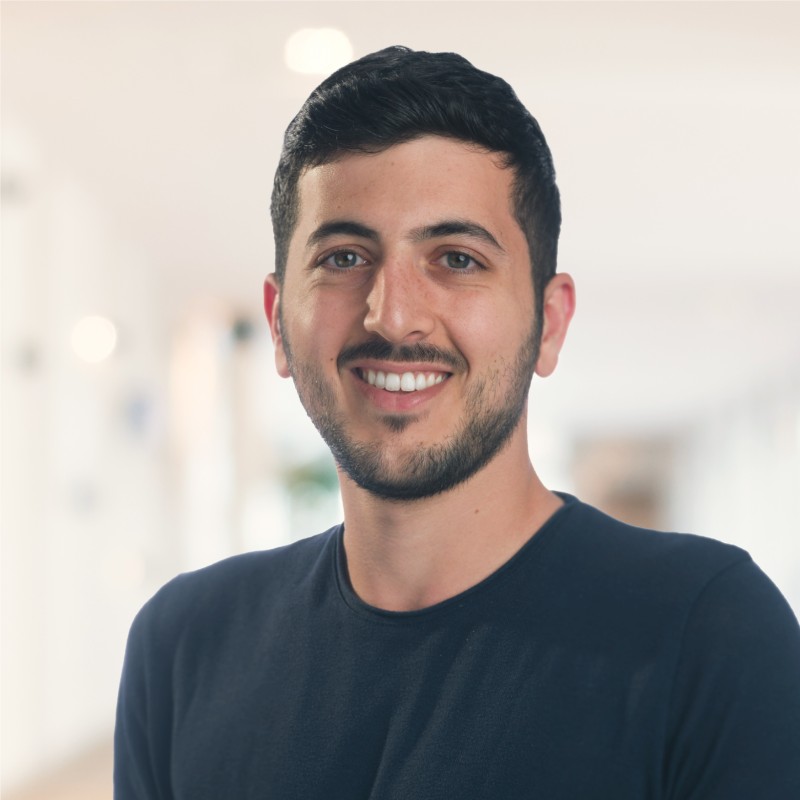

Nagish attended the inaugural SlxAI Summit 2026 at Boston University.
Researchers, companies, universities, Deaf leaders, interpreters, and accessibility organizations came together in one room to talk about the future of sign language and AI.
SLxAI describes the summit as an effort to unite industry leaders and establish a cooperative nonprofit to help shape the field. According to the event’s organizers, 220 attendees from 106 organizations in 19 countries were present.
What Happened at SLxAI2026
The summit made clear how broad this space has become. Some sessions focused on ethics, governance, and Deaf leadership - including questions on data ownership, accountability, and cultural sovereignty. Others covered data creation, human-AI collaboration, product design, and real-time use cases.
Nagish’s Head of Research, Dr. Amit Moryossef, presented his talk “The Future of Sign Language Translation is Transcription.”
Sign language AI requires better representations. SignWriting acts as a structured bridge between sign languages and text-based AI systems, one that could enable more scalable, multilingual translation and generation.
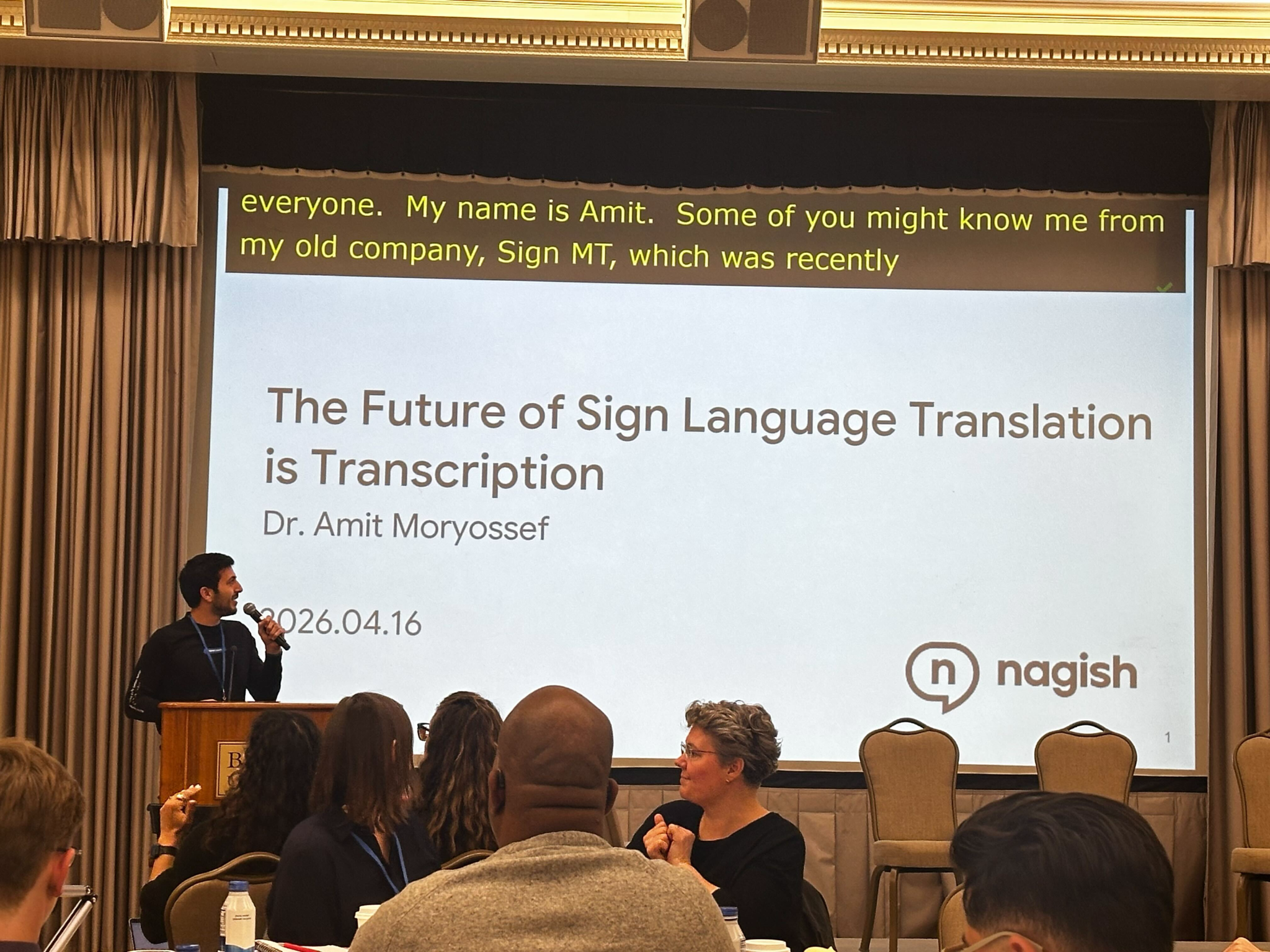
That matters because video is a hard substrate for language technology. It is rich, but expensive, ambiguous, and difficult to scale. If the field wants systems that go beyond impressive demos toward genuinely robust translation, representation is going to be one of the key challenges to solve.
That theme came up in other presentations too. Boston University Deaf Center’s Dr. Naomi Caselli and Dr. Kaj Kraus, presented on how linguistic properties such as simultaneity, iconicity, spatial grounding, and eye gaze should shape sign language AI from data collection through annotation, model design, and error analysis.
Amit has been working on sign language AI since 2019, across his PhD, postdoctoral research, and industry work, at the intersection of machine translation, language technology, and visual AI. He can converse, at varying pace, in American, Israeli, and Swiss German Sign Languages, and his research focus has shifted over time from recognizing signs in video toward how signed languages can be represented in ways that AI systems can translate, reason over, and generate, including through representations such as SignWriting.
His role in this space has developed through years of sustained research, direct engagement, and a real effort to help build the field from within.

What the Sign Language AI Field Needs Now
Together with Amit in attendance was Matt Sherman, Nagish’s Head of Community whose work sits at the intersection of community building and the future of how SLxAI will be shaped. The future of sign language AI cannot be defined only by technical capability. It also has to be shaped by the people and communities these new solutions are meant to serve.

Progress or Paralysis
For Matt, one of the clearest takeaways from SLxAI is that the field is standing at a crossroads and the choices it makes next will define how far it goes.
The ethical questions in sign language AI are real and deserve serious attention: data ownership, consent, cultural sovereignty, who benefits, and who gets to decide. These conversations are necessary.
But there’s a version of those conversations where necessary caution becomes a reason to stall, where the weight of every unanswered question slows the field to a crawl while the people who need these tools keep waiting.
In Matt’s perspective, the community has to decide whether it wants to fall behind on the same barriers that have always slowed progress, or move forward with a bias towards action - making collective decisions faster and reducing the red tape that functions as a barrier to progress rather than a safeguard for it. Consider all the ethics questions. Engage them seriously. And then keep building - not in spite of that rigor, but because of it.
Progress for the sake of innovation alone isn’t the goal. But neither is letting procedural caution become a substitute for forward motion.
Scaling to Meet a Widening Gap
The collaborative energy at SlxAI also brought into focus how much time has already passed. The demand exists. The community exists. The need has existed for a long time.
The gap between what sign language AI can currently do and what it needs to do is not narrowing fast enough. Every day that the tools are not good enough is another day that deaf and hard of hearing people are navigating a world that was not built for them. For Matt, that lived experience was very familiar long before this space got any real attention.
Moving forward means every key contributor and player in this space shares the compromises they are willing to make to move more effectively as a field. It means exploring every possible resource and source of funding this space deserves. And it means welcoming everyone who can contribute constructively - deaf and hearing alike.
Sign language AI is not a problem any single community, company, or discipline can solve alone. The room at SLxAI reflected that. The field needs to keep reflecting it.
What Comes Next
We’re experiencing the early sign to text and text to sign moments of sign language. Lots of concerns, a lot is unknown, and there’s a long way to go, but there’s no doubt that real progress is being made. What research must focus on is staying grounded in the communities these tools are meant to serve, and remain accountable to the people whose lives depend on getting this right.
That means more collaboration across research, industry, and the deaf community. It means funding that matches the scale of the problem. It means moving faster on the things the field agrees on, while continuing to work through the things it doesn’t.
We were proud to be part of SLxAI 2026. We are looking forward to what comes next.


Matt Sherman is the Head of Community at Nagish, where he serves as a bridge between the company and its community, working to identify accessibility needs and break down communication barriers. He leads conferences, partnerships, strategic initiatives, and advocacy efforts, while also nurturing Nagish’s online and offline communities to keep them thriving and growing every day. Outside of work, Matt is an avid outdoorsman who enjoys fishing and exploring the serenity of Minnesota’s land of 10,000 lakes.
Dr. Amit Moryossef is a researcher and entrepreneur in sign-language technology. He completed his Ph.D. at Bar-Ilan University and a postdoc at the University of Zurich. He founded sign.mt, a real-time sign-language translation platform, which was recently acquired by Nagish, where he now leads research. His work has received multiple best paper awards at ACL and EMNLP, focusing on making signed languages accessible through machine learning.